|








 The Autorun.inf file (in Windows), What is it? The Autorun.inf file and the Windows AutoRun technology  When
you create a CD/DVD menu with
SamLogic CD-Menu
Creator
you have the option to create a file with the name Autorun.inf.
This file is very important if you want to create an autorun / autoplay
menu (a menu that opens automatically) because it instructs Windows
which application that should be launched when the CD or DVD is inserted
in the drive. When
you create a CD/DVD menu with
SamLogic CD-Menu
Creator
you have the option to create a file with the name Autorun.inf.
This file is very important if you want to create an autorun / autoplay
menu (a menu that opens automatically) because it instructs Windows
which application that should be launched when the CD or DVD is inserted
in the drive.The Autorun.inf file must always be located in the root directory of the CD/DVD. If you place it in a sub directory Windows will not found it. When you insert the disc Windows will look after Autorun.inf in the root directory and if it find it, it will read the file and interpret the contents of it. This feature to automatically start programs on compact discs is sometimes referred as the Windows AutoRun technology. All versions of Windows since Windows 95 have had this technology built-in. Almost all software that is distributed via CD or DVD uses this technology to automatically open menus or start programs. You can read more about this in the related article: Why Create an Autorun Menu For Your CD or DVD?. What is inside Autorun.inf? Autorun.inf is a text file and in its basic form it look like this:
The OPEN command specifies which program that should be run when the CD/DVD is inserted in the drive. In the example above a program with the name MYAPP.EXE will be executed. When you create an Autorun.inf file you can use Notepad as an editor. The example above should look like this in Notepad: 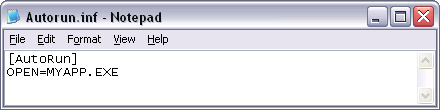 Autorun.inf can also specify an icon that will represent your application's CD or DVD in the Windows user interface (for example in Windows Explorer). To specify a new icon to the CD/DVD drive, Autorun.inf should contain the following commands:
The ICON command specifies the filename of the new icon to display. In this case an icon with the filename MYICON.ICO will be used. In the examples above the program file and the icon file most be located in the root directory of the CD/DVD, but you can also access files located in a sub directory on the CD/DVD if you specify a relative path. Example:
The OPEN and ICON commands are the most used in Autorun.inf files, but there are more commands available. You can for example specify a new disc label with the LABEL command. The LABEL command has the benefit that you can specify labels that contains more than 16 characters (16 is the normal limit for CD/DVD labels). A list and a description of the commands that can be used in the Autorun.inf file can be found at the following page on our web site: Autorun.inf - Commands. If you want a more detailed information about the commands you can also take a look at the following page on Microsoft web site: Autorun.inf Entries. Is it possible to show documents automatically with Autorun.inf? Yes, it is possible. There is a command with the name SHELLEXECUTE that can be used to open documents automatically. If you specify a filename after SHELLEXECUTE, for example like this:
the command will open the document automatically when the CD/DVD is inserted in the drive. In this case a file with the name INFO.TXT will be opened automatically. The SHELLEXECUTE command can be used to automatically open for example Word, PDF or HTML files, or play movies. But you should be aware of that there must exist a program that can read the document or movie format, otherwise the command will fail. If you use SHELLEXECUTE to open a PDF file, there must be a copy of Adobe Reader installed. Otherwise the PDF can not be opened. If you want to handle cases where a viewer program might be missing, you can use a general document launcher program instead. For example our program SamLogic Autorun Creator will handle cases when a proper viewer program is missing. In some computers the AutoRun feature do not seems to work, why? As mentioned before, all Windows since Windows 95 have the AutoRun technology built-in, but sometimes this feature is disabled in some computers. The AutoRun function can be disabled for different reasons and by using different methods. In this blog post on our blog you can read more about why AutoRun sometimes is disabled and how to turn it on again:  Why
does not AutoRun work with my CD / DVD drive? Why
does not AutoRun work with my CD / DVD drive?We recommend you also to read this technical article that explains how AutoRun can be disabled, and enanbled, by changing a value in Windows Registry: How to
Enable/Disable Autorun for a Drive (using Registry)
Related products: SamLogic CD-Menu Creator Other articles More articles are available from the article index page. |
 |



| Article written by: Mika Larramo | Swedish |